AI Investigator: Automated Research Pipeline
CompletedAutonomous research agent that scrapes URLs, qualifies enterprise AI case studies, and generates structured reports. Built in a weekend in response to an Arvid Kahl tweet.
Overview
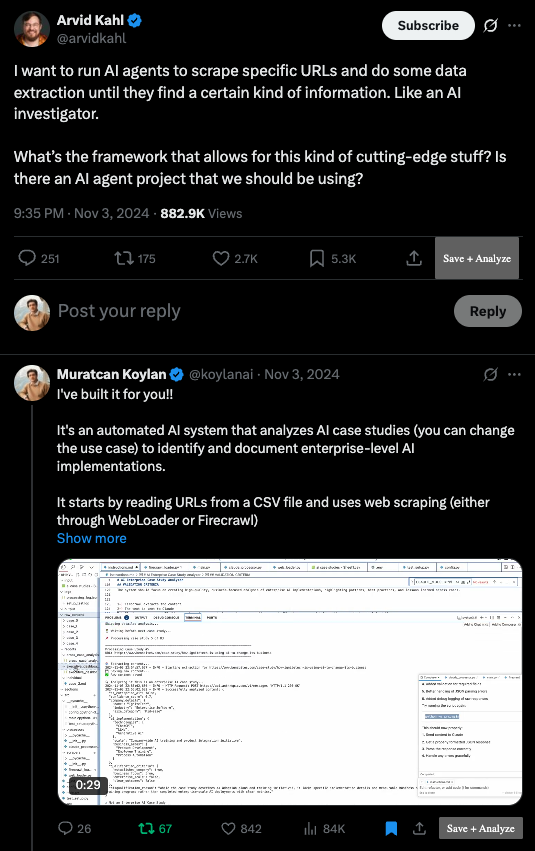
On November 3rd, 2024, Arvid Kahl tweeted: “I want to run AI agents to scrape URLs and do data extraction until they find specific information. What’s the framework for this?”
I built and open-sourced it over the weekend. It picked up traction the following week.
The Problem
Arvid’s need was specific: automated research that could scrape links, determine relevance, and generate structured reports. He wanted to find enterprise AI case studies without manually reviewing hundreds of pages.
I had the same pain point from years of researching case studies for marketing campaigns.
What It Does
A modular Python system that autonomously researches enterprise AI case studies:
- Input: CSV of URLs or a company website to crawl
- Processing: Firecrawl scrapes content, Claude 3.5 Sonnet qualifies and analyzes
- Output: Three structured report types (individual case analysis, cross-case patterns, executive dashboard)
The architecture is intentionally simple: Discovery → Qualification → Analysis → Synthesis. Async processing handles 50+ URLs in ~10 minutes.
Key Technical Choices
- Firecrawl API: Handles both link discovery (
/v1/map) and content extraction (/v1/scrape) - Two-stage Claude analysis: First qualifies enterprise relevance, then generates deep reports if passed
- Modular design: Scrapers, processors, and orchestration are cleanly separated
- State management: Idempotent processing with detailed logs for debugging
Distribution
Shipping inside the window of Arvid’s tweet mattered. The repo picked up a few hundred stars over the following weeks and developers started adapting it for market research and academic literature reviews.
What It Became
This was a prototype for what later became context orchestration: specialized agents discovering, qualifying, and synthesizing information in parallel. The same pattern, productized for strategic marketing rather than case study research, is what I built at 99Ravens.
Building in public reinforced one habit: ship the smallest workable system, then iterate. Solo weekend development forces prioritization. No complex infrastructure, no UI — just the core workflow, error handling, and docs. That produced cleaner code than my over-engineered side projects.
The most useful outcome was seeing developers adapt the codebase. One extended it into a literature review synthesis tool for academic papers.
The repository remains open but is unmaintained. It served its purpose as a reference implementation for autonomous research agents.