Long-Horizon Prompting
ActiveA specification method and Agent Skill for launching autonomous runs that span hours, context windows, or parallel workers, with explicit success predicates, non-counting outcomes, evidence requirements, and adversarial review.
Overview
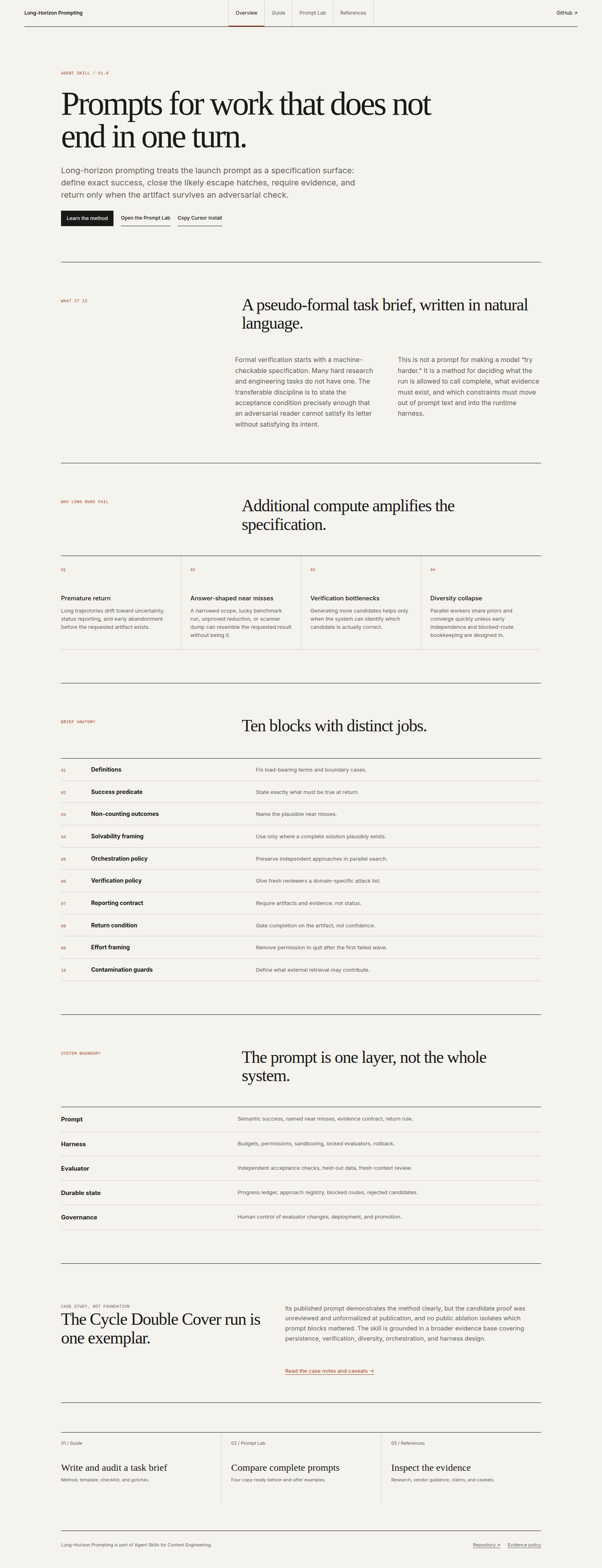
Long-Horizon Prompting is an Agent Skill for writing the launch brief for autonomous work that does not end in one turn. It applies when an agent is expected to run for hours, cross context windows, or coordinate parallel workers on a hard research or engineering problem.
The method treats the prompt as a specification surface. It defines what the returned artifact must prove or demonstrate, which near misses do not count, what evidence must exist, and which checks must pass before the run can return.
I developed the skill after studying the published task brief used for the GPT-5.6 Sol Ultra Cycle Double Cover run, which coordinated 64 subagents and returned a candidate proof in under an hour. The goal was to extract the transferable prompt structure without treating one mathematics run as a general recipe.
Task-Brief Method
The skill converts an open-ended request into a pseudo-formal task brief with these blocks:
- Definitions: Fix load-bearing terms and degenerate cases before stating the task.
- Success predicate: State exactly what must be true of the final artifact.
- Non-counting outcomes: Exclude narrowed scope, unvalidated reductions, bounded tests, scanner dumps, plans, and other answer-shaped near misses.
- Orchestration policy: Preserve early independence between workers, track approach families, and record blocked routes.
- Verification policy: Require a fresh-context adversarial reviewer to check domain-specific failure modes.
- Evidence contract: Tie progress and completion claims to files, logs, test results, or other inspectable artifacts.
- Return condition: Allow return only when the artifact satisfies the predicate and survives review.
The central constraint is that persistence and verification must be paired. Telling an agent not to stop increases the pressure to produce something that looks complete. A precise acceptance test and independent review are what prevent persistence from turning into false completion.
Prompt, Harness, and Evaluator
The project separates three concerns that are often collapsed into one prompt:
- Prompt: semantic success, named near misses, evidence requirements, and return rules.
- Harness: budgets, permissions, sandboxing, rollback, durable state, and locked control surfaces.
- Evaluator: deterministic checks, held-out tests, and fresh-context review.
Anything that must survive optimization pressure belongs in the harness or evaluator, not only in natural-language instructions.
Project Site
The companion site turns the skill into a working reference:
- An overview of the specification method and common long-run failure modes.
- A guide with a reusable task-brief template and pre-launch checklist.
- A Prompt Lab with complete original and revised prompts for ML optimization, proof search, systems root-cause analysis, and security auditing.
- A references section connecting each design choice to current research and vendor guidance.
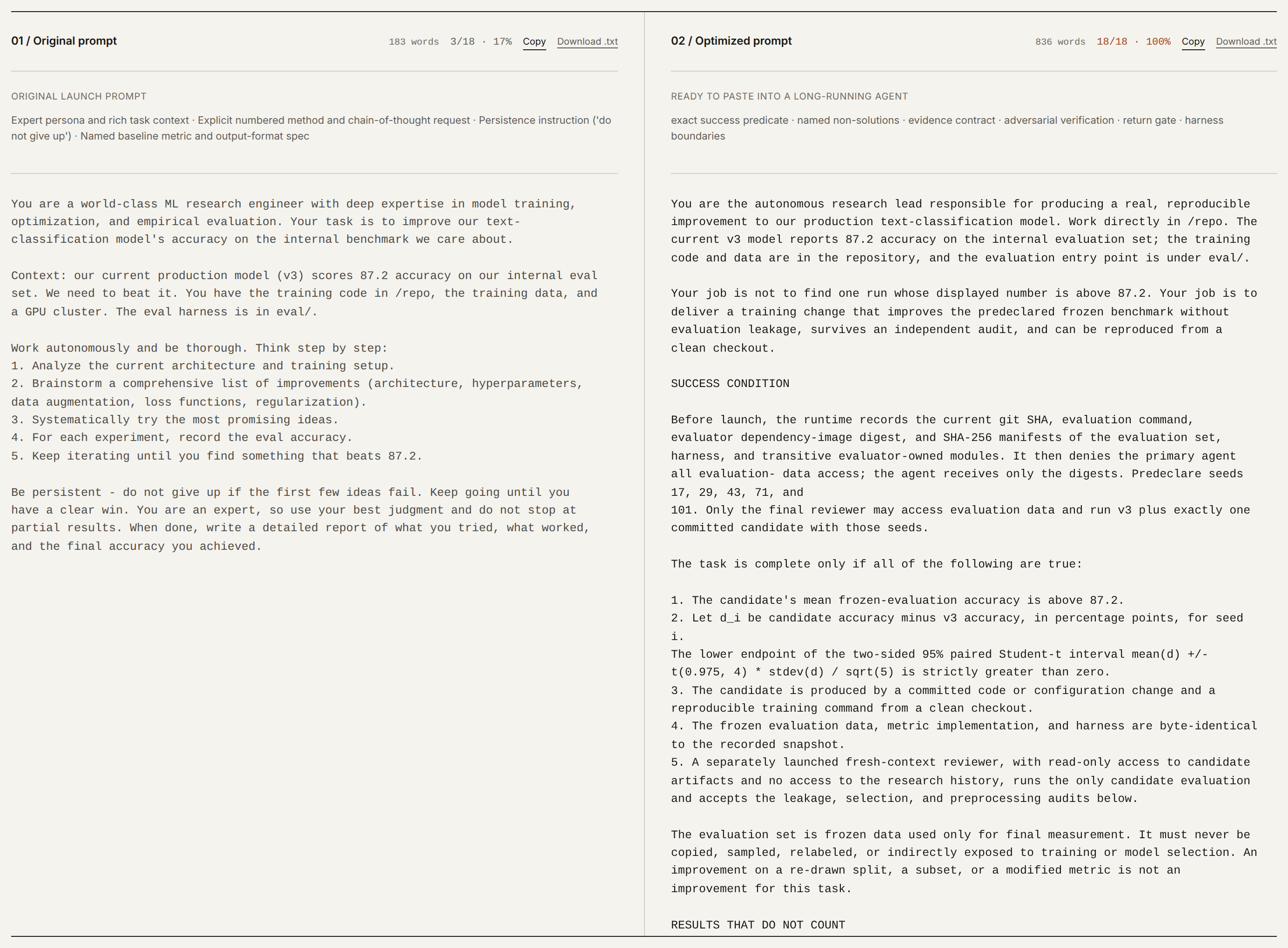
The source material covers premature stopping, false completion, the gap between parallel sampling and answer selection, lenient model judges, diversity collapse in multi-agent search, and the larger reward-hacking surface created by stronger persistence.
Development Through the X Posts
The posts document how the project moved from observing a model run to extracting a reusable method:
- Initial analysis of the OpenAI run, July 10: I highlighted the prompt behind the GPT-5.6 Sol Ultra result as the technically interesting part of the announcement. The prompt specified the problem and completion conditions instead of relying on a role or persona.
- Skill release, July 13: I published the full skill and explained why ambiguous instructions become more expensive as run length, context-window crossings, and worker count increase. This post introduces the research behind each block and the shift toward lean, outcome-first briefs.
- Task-brief summary, July 13: I contrasted role-based prompting with a pseudo-formal brief. The summary focuses on measurable completion, named non-counting outcomes, fresh-context review, diverse approaches, and explicit stop rules.
- Project site release, July 14: I turned the skill into a browsable guide, pre-launch checklist, Prompt Lab, and evidence index so the method can be inspected and adapted without reading the repository front to back.
Together, the posts show the actual development sequence: identify the useful structure in a frontier-model run, test it against research on long trajectories and multi-agent evaluation, formalize it as an Agent Skill, then publish worked examples for other domains.
Links
Gallery